VoIP has become much bigger than simply making phone calls over the internet.
Today, the technology sits behind business phone systems, SIP trunks, cloud PBX platforms, contact centers, softphones, mobile applications, WebRTC solutions, unified communications platforms, and increasingly AI-powered voice applications.
With so many technologies involved, finding reliable information can sometimes be difficult.
That is where VoIP Communities & Forums can be useful.
A good community gives you somewhere to ask questions when documentation doesn't provide the answer. It can also help when you're dealing with a problem that crosses multiple systems.
For example, a SIP call that fails may not have a simple cause. The problem could involve the PBX, SIP provider, firewall, NAT, DNS, authentication, routing, codecs, or the network itself.
Someone else may already have experienced the same issue.
This is one of the biggest advantages of technical communities. Instead of troubleshooting every problem from scratch, you can search previous discussions, compare configurations, read other users' experiences, and ask questions of people who work with similar technologies.
There are also many different types of VoIP communities.
Some focus on a particular platform such as Asterisk, FreePBX, 3CX, or FusionPBX. Others are built around a specific provider. Some communities focus heavily on SIP and telecom standards, while others are broader and include everything from IP phones to cloud PBX systems.
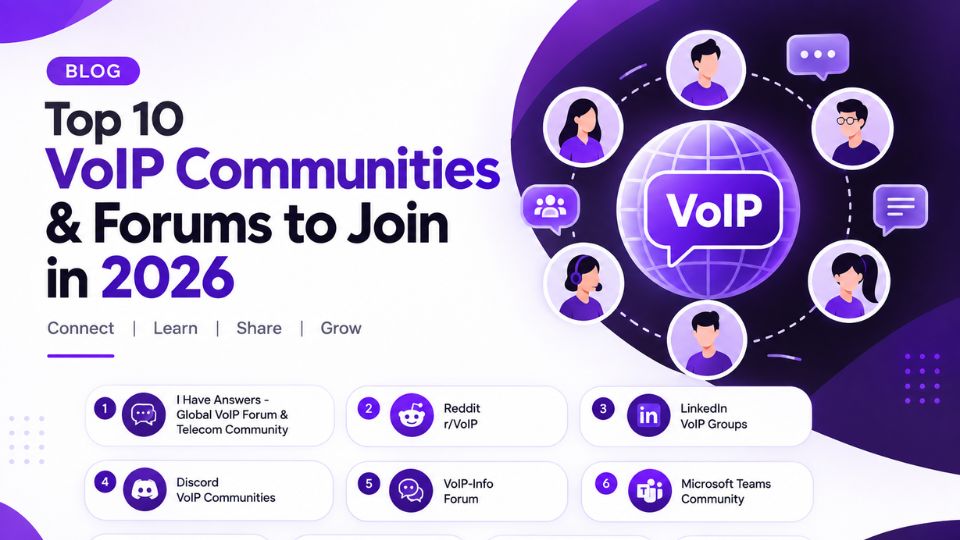
This list brings together ten communities and forums that are relevant to VoIP and telecom discussions in 2026.
They serve different audiences, so the right community for you will depend on the technology you use, the type of problem you're trying to solve, and the kind of discussions you want to follow.
1. I Have Answers – Best VoIP Community
I Have Answers – Global VoIP Forum & Telecom Community is a community built around the people who work with, learn about, and troubleshoot modern voice and telecom technologies.
The goal is simple: create a place where VoIP and telecom professionals, engineers, developers, administrators, providers, and enthusiasts can discuss real-world problems and share practical knowledge.
Unlike a community focused on only one PBX platform, the idea behind I Have Answers is to cover the wider VoIP and telecom ecosystem. That includes technologies such as SIP, SIP trunking, VoIP, IP-PBX, PBX systems, SBCs, RTP, WebRTC, softphones, IP phones, call routing, telecom infrastructure, and troubleshooting.
One of the most useful parts of a general VoIP community is that not every problem belongs to a single vendor or platform. A SIP registration problem, for example, can involve the PBX, SIP provider, firewall, NAT configuration, DNS, authentication, codecs, or network routing. Having a place where these subjects can be discussed together can be valuable for people working across different systems.
The community can also be useful for people who are still learning VoIP.
Someone who is new to SIP may start with a basic question such as:
What is the difference between SIP and VoIP?
Later, the same person may be asking about SIP response codes, RTP ports, SIP authentication, NAT traversal, SIP trunks, or diagnosing a failed call.
That progression is a normal part of learning telecom technology, and community discussions can become a useful knowledge base over time.
What can you discuss there?
Topics can range from beginner questions to advanced technical discussions, including:
- SIP registration problems
- SIP 403 Forbidden errors
- SIP trunk configuration
- One-way audio
- No-audio calls
- RTP and media issues
- NAT and firewall problems
- IP-PBX configuration
- Asterisk and FreePBX
- SBC configuration
- VoIP security
- AI Agents
- AI Voice Agents
- AI Automation
- Call routing
- DID and number-related questions
- IP phones and softphones
- WebRTC
- VoIP providers and carriers
- Telecom infrastructure
- Troubleshooting and diagnostics
Another important aspect of a community is the ability to learn from other people's problems.
For example, a person searching for information about a SIP 403 Forbidden response may find a discussion explaining that the response can have different causes depending on the provider and configuration. Someone else may have already posted SIP logs, configuration details, and the eventual solution.
That type of discussion can be useful long after the original question has been answered.
As the community grows, its forum discussions can also become a resource for people searching for practical answers to VoIP and telecom questions.
For professionals, communities like this can provide a place to exchange experiences that are sometimes difficult to find in documentation alone. Official documentation explains how a system is supposed to work, while community discussions often show what happens when something doesn't work as expected.
2. Asterisk Community
The Asterisk Community is one of the most established communities in the open-source communications world.
Asterisk is an open-source communications platform that has been used to build PBX systems, VoIP applications, call-routing systems, contact-center solutions, and many other communications applications.
The official Asterisk community provides several ways for users and developers to participate, including forums, developer discussions, documentation, issue reporting, code reviews, IRC channels, and community events. The project says its community includes more than 86,000 registered users, developers, and advocates.
The Asterisk forum is particularly useful for people working directly with the platform.
The discussions cover a wide range of technical subjects. Current forum categories include areas such as SIP, support, endpoints, APIs, dialplans, integration, deployment, WebRTC, hardware, and development.
That makes it useful for both everyday administration and more advanced development work.
For example, someone working with PJSIP might run into an authentication problem while configuring a SIP endpoint. Another administrator might be dealing with calls that connect but have no audio. A developer may be working with ARI or AMI and need help understanding a particular behavior.
These are exactly the types of problems where community discussion can be helpful.
The Asterisk community also has a strong developer side.
Developers can participate in discussions about bugs, patches, new functionality, architecture, APIs, and other areas of Asterisk development. The project also provides dedicated communication channels for developers.
For someone learning Asterisk, the community can therefore serve several purposes at once:
- Learning basic Asterisk concepts
- Troubleshooting configuration problems
- Understanding SIP and PJSIP
- Working with dialplans
- Developing applications around Asterisk
- Connecting Asterisk with other systems
- Working with APIs
- Discussing endpoints and hardware
- Learning about new releases and features
The technical nature of many Asterisk discussions also makes the community useful as a reference when researching a problem.
If you are searching for an answer to an Asterisk issue, it is often worth checking whether somebody has already encountered the same behavior. In many cases, previous discussions can point you toward configuration details, logs to collect, or areas of the system that should be investigated.
For VoIP engineers and developers who regularly work with open-source telephony, the Asterisk community remains an important place to follow.
3. FreePBX Community
The FreePBX Community is another major community for people working with open-source PBX and VoIP systems.
FreePBX provides a graphical interface for managing Asterisk, making it possible to configure many PBX functions without working entirely from the command line.
The official FreePBX community provides forums, documentation, a wiki, webinars, feature discussions, bug reporting, and other resources. The project describes FreePBX as an open-source IP PBX and says its community includes developers, integrators, and enthusiasts.
The FreePBX forums are particularly relevant when the question involves configuring or troubleshooting a PBX.
Common discussion areas can include things such as:
- Extensions
- SIP trunks
- Inbound routes
- Outbound routes
- IVR
- Ring groups
- Call queues
- Voicemail
- Follow-me
- Time conditions
- Endpoint configuration
- Firewall settings
- Security
- Asterisk configuration
- Module-related problems
- Updates and upgrades
- Troubleshooting
One reason FreePBX discussions can be useful is that a problem may involve several layers of the system.
For example, a SIP trunk that is not registering might appear to be a simple configuration problem. But the actual cause could involve credentials, provider restrictions, firewall rules, DNS, NAT, network connectivity, or the underlying Asterisk configuration.
Community discussions can help users work through these possibilities instead of simply changing random settings and hoping the problem disappears.
The FreePBX community also has a strong knowledge-sharing element. Its official community resources include a wiki covering subjects ranging from setup to troubleshooting, while the forums provide a place for users to discuss deployment scenarios, configuration questions, and technical problems.
For someone new to VoIP, FreePBX can also be a practical way to learn how different PBX components fit together.
You might begin by creating an extension and registering a SIP phone. Then you may move on to configuring a SIP trunk, creating inbound and outbound routes, building an IVR, setting up a queue, and eventually integrating the PBX with other systems.
That makes the FreePBX community relevant not only when something breaks, but also when someone is trying to understand how a real-world IP-PBX is put together.
The community's guidelines also encourage users to search existing discussions before creating new topics, which helps preserve useful technical information and reduces duplicate questions.
For anyone working with FreePBX, Asterisk-based PBX systems, SIP trunks, and business phone systems, the FreePBX community is therefore a useful place to learn from other users and find solutions to practical problems.
4. 3CX Community Forum
The 3CX Community Forum is a large online forum focused on 3CX, business communications, IP-PBX systems, SIP trunks, IP phones, integrations, and related technologies.
For people who work with 3CX, the forum is one of the places where users can discuss configuration questions, troubleshooting problems, product updates, integrations, and real-world deployments.
The forum is not limited to one type of technical question. Its current categories include Phone System / PBX, SIP Trunks, IP Phones, Apps / Clients, AI, Live Chat / Messaging, Integrations, Server, Small Business / SOHO, and several international-language sections.
That variety is useful because a problem with a business phone system can involve several different components.
For example, a user might have a 3CX installation where calls are working internally but outbound calls are failing. The issue could be related to the SIP trunk, caller ID, routing rules, provider configuration, firewall, or another part of the deployment. A forum discussion gives users a place to explain the situation and compare possible solutions.
The forum is also useful for IP phone configuration.
Current discussions include phones from manufacturers such as Yealink, Fanvil, and Snom, along with questions about registration, firmware, configuration, and compatibility.
Another area that has become increasingly visible in 2026 is AI.
The 3CX forum now has a dedicated AI section, with discussions around AI-related functionality, AI agents, call summaries, and newer integrations. 3CX announced the dedicated AI section as part of a 2026 forum reorganization.
This is a good example of how VoIP communities are changing. Traditional PBX discussions are still important, but modern business communications are increasingly connected with AI, CRM systems, messaging, mobile applications, analytics, and automation.
The size of the 3CX forum is another notable point. The forum currently displays more than 112,000 threads, 590,000 messages, and 165,000 members, although these figures can change as new users and discussions are added.
There is also an international side to the community, with forums available in languages including French, German, Italian, Spanish, Russian, Portuguese, Dutch, Turkish, and Polish.
What can you find in the 3CX community?
Some common areas include:
- 3CX PBX configuration
- SIP trunk problems
- Outbound calling issues
- Caller ID configuration
- IP phone setup
- Yealink, Fanvil, and Snom devices
- Mobile applications
- Web Client
- SBC configuration
- CRM integrations
- Microsoft Teams integrations
- Call Flow Designer
- AI functionality
- Live Chat and messaging
- Server and deployment questions
- Product releases and updates
The forum can be especially useful when searching for a very specific 3CX problem because previous discussions often contain configuration examples and troubleshooting steps.
3CX also says its forum is actively facilitated by company staff and experienced community contributors, with staff members participating in discussions alongside partners and users.
For someone running a 3CX-based phone system, that combination of product-specific discussions, community experience, and official participation makes the forum a useful source of information.
5. Cisco Community – IP Telephony and Collaboration
When talking about VoIP and enterprise communications communities, Cisco Community is another major resource worth knowing.
Cisco's community covers a much broader technology landscape than VoIP alone, but its IP Telephony and Phones and collaboration sections contain a substantial amount of information related to enterprise voice and unified communications.
The IP Telephony and Phones area currently includes discussions covering technologies such as Cisco Unified Communications Manager (CUCM), IP phones, collaboration endpoints, gateways, contact center technologies, and other IP telephony subjects.
This makes it particularly relevant for engineers and administrators working with enterprise communications environments.
Cisco environments can be considerably more complex than a small office PBX. A deployment may involve phones, call-control servers, gateways, SIP trunks, session border elements, conferencing systems, contact centers, network infrastructure, and security components.
As a result, troubleshooting often crosses traditional technology boundaries.
A voice problem might initially look like a PBX issue but turn out to involve DNS, routing, firewall rules, SIP signaling, certificates, device configuration, or network behavior.
This is one reason large technical communities can be useful. A question can attract responses from people who have worked with different parts of the same technology stack.
Cisco's IP Telephony and Phones community currently shows thousands of discussions associated with areas such as CUCM, IP phones, collaboration endpoints, and related technologies.
Topics commonly discussed
Depending on the section, users can find discussions involving:
- Cisco Unified Communications Manager
- SIP
- IP phones
- Voice gateways
- Collaboration endpoints
- Call routing
- Enterprise telephony
- Contact centers
- Unified communications
- Webex-related technologies
- Troubleshooting
- Configuration problems
- Firmware and device issues
- Network-related voice problems
The community can be particularly useful for people dealing with Cisco-based environments because older discussions can provide valuable background when troubleshooting a long-running system.
For example, an administrator dealing with a SIP or IP phone problem may find that another user previously encountered a similar issue. The older discussion may contain configuration examples, log information, suggested tests, or explanations of how a particular Cisco component behaves.
Cisco Community also has dedicated collaboration and voice-and-video areas rather than treating all communications questions as one large category.
That organization makes it easier to narrow a search when the problem involves enterprise voice.
Another useful aspect is the range of experience represented in the community. Discussions can involve everyday administration as well as more advanced enterprise deployments.
For someone who works with Cisco UC technologies, this can make the community useful both for troubleshooting and for researching how other administrators approach particular deployment scenarios.
It is also worth remembering that Cisco Community is not exclusively a VoIP forum. It covers networking, security, data centers, wireless, collaboration, and many other Cisco technologies.
That broader focus can actually be helpful when the voice problem turns out to involve something outside the PBX itself.
A VoIP system ultimately depends on the network underneath it. Having access to a community that covers both communication systems and networking can therefore be useful when diagnosing problems that cross multiple layers.
6. VoIP.ms Community Forum
The VoIP.ms Community Forum is a community centered around VoIP.ms services, but the discussions cover many practical VoIP topics that are relevant to everyday users.
The community describes itself as a peer-driven space for configurations, tips, and troubleshooting.
Unlike a large vendor-neutral telecom forum, this community is closely connected with a specific VoIP service. That gives it a different type of value.
Users can discuss actual experiences with SIP registration, calling, SMS, MMS, softphones, ATA devices, routing, caller ID, and other features of the service.
The forum is active in 2026, with new discussions appearing regularly.
Recent topics include SIP registration status, outgoing calling problems, softphone issues, SMS and MMS, ATA configuration, routing, caller ID, and VoIP-related troubleshooting.
For example, recent discussions have covered issues such as:
- Calls going directly to voicemail
- VoIP.ms API questions
- SIP registration status
- Softphone problems
- MMS issues
- ATA configuration
- Outbound routing
- Caller ID
- One-way audio
- Grandstream device problems
- SMS delivery
- Call queues
- Number registration
The forum can therefore be useful for people who want practical information rather than only general VoIP theory.
One interesting thing about the discussions is the range of devices and applications involved.
Users have discussed equipment such as Grandstream ATAs and IP phones, as well as softphones and other SIP-compatible applications. The forum therefore gives readers an idea of how different pieces of consumer and small-business VoIP equipment interact with a hosted VoIP service.
There are also discussions that go beyond simple account configuration.
For example, users have discussed one-way audio problems related to network environments such as CGNAT, registration failures, SIP behavior, SMS, and other issues that require some understanding of how VoIP works underneath the user interface.
That makes the forum interesting even for people who are learning VoIP.
You can see real questions from people trying to understand why something works in one environment but not another. Those conversations can help beginners become familiar with terminology such as DID, SIP registration, ATA, softphone, routing, caller ID, and RTP-related audio problems.
The community is also not limited to technical troubleshooting.
There are sections for general discussions, suggestions and feedback, news, and product-related topics. Recent conversations have included questions and feedback around new softphone features, AI voice functionality, messaging, and other developments.
For people already using VoIP.ms, this makes the community a place to exchange experiences with other users.
For people researching VoIP, it can also provide examples of the kinds of problems that appear in real-world hosted VoIP deployments.
The forum is particularly useful when you are looking for a practical answer to a specific problem rather than a general explanation of VoIP.
And because discussions continue to be posted throughout 2026, it remains an active source of current user experiences rather than simply an archive of older VoIP information.
7. VoIP-Info Forum
The VoIP-Info Forum is one of the long-running online communities focused on VoIP, PBX systems, SIP, IP phones, providers, and related communications technologies.
What makes the forum interesting is its broad coverage. It isn't tied to only one VoIP platform, so discussions can move between different PBX systems, providers, phones, and technologies.
The forum currently has more than 26,000 threads, 175,000 messages, and 20,000 members, with new discussions continuing to appear in 2026.
That gives it a substantial archive of conversations that can be useful when researching older VoIP problems.
The forum has dedicated sections covering technologies and platforms such as Asterisk, 3CX, Incredible PBX, IP phones, trunks, providers, and other VoIP subjects.
This broad approach is useful because VoIP problems don't always fit neatly into one vendor's ecosystem.
A user might be running Asterisk but using a third-party SIP provider and a mixture of Yealink and Grandstream phones. Another person might be running a hosted PBX while troubleshooting SIP URI calling or PSTN connectivity.
A general VoIP forum gives users somewhere to discuss those situations without having to move between several separate vendor communities.
What can you find on the VoIP-Info Forum?
Some of the discussion areas include:
- Asterisk
- 3CX
- Incredible PBX
- IP phones
- SIP trunks
- VoIP providers
- SIP URI
- FreePBX
- FreeSWITCH
- Call routing
- Softphones
- Hardware
- VoIP services
- Troubleshooting
- Telecom news
- VoIP-related products and services
The activity in 2026 also shows how broad the discussions have become.
Recent topics include SIP URI calling, PSTN calling problems, FreePBX commands, SIP phones, provider issues, PBX software, and newer technologies such as AI voice applications.
That mix is valuable because the VoIP industry itself has changed significantly.
VoIP is no longer simply about replacing a traditional telephone line with an IP connection. Modern deployments can involve cloud infrastructure, APIs, WebRTC, AI voice applications, messaging, programmable communications, SIP trunks, security systems, and complex carrier interconnections.
A community with a broad technical scope can therefore be useful when a problem doesn't belong to one specific product.
The forum can also be useful for people researching a provider or technology before deploying it.
For example, instead of relying only on a provider's marketing material, someone can search community discussions to see what other users have experienced with particular services, configurations, or devices.
That doesn't mean every community post should automatically be treated as fact. User experiences can be different, and technical information can become outdated. But discussions can provide useful leads and questions to investigate further.
Another advantage is the depth of the archive.
Some VoIP problems are surprisingly persistent. SIP registration, NAT, codec negotiation, caller ID, one-way audio, routing, and PBX configuration problems have been appearing in different forms for years.
Older discussions can therefore still provide useful background, especially when the underlying technology has not fundamentally changed.
For someone looking for a broad VoIP discussion community rather than a forum dedicated to one particular PBX, VoIP-Info is worth exploring.
8. SIP Forum
The SIP Forum is different from many of the communities on this list because it has a strong industry and interoperability focus.
The organization describes itself as an industry association whose mission is to advance the adoption and interoperability of IP communications products and services based on Session Initiation Protocol (SIP).
For anyone working seriously with SIP, that makes it an important community to know.
SIP is one of the foundations of modern IP communications. It is used for establishing and managing communication sessions across many different systems, including VoIP services, enterprise communications platforms, carriers, and other real-time communication applications.
The SIP Forum brings together participants from across the IP communications industry rather than focusing on a single PBX product.
Its activities include technical working groups, interoperability efforts, educational resources, industry discussions, and events. The organization says its working groups and task groups have their own mailing lists and contributors.
That makes the community particularly relevant for people interested in the technology behind VoIP rather than only the administration of a particular phone system.
Why SIP Forum matters to VoIP professionals
SIP interoperability is one of the practical challenges of telecom.
A SIP-based communication system can involve:
- A carrier
- A SIP trunk
- An SBC
- An IP-PBX
- A softphone
- An IP phone
- A gateway
- A mobile or web application
- A downstream carrier
- Multiple networks
All of these systems need to communicate correctly.
When implementations don't behave consistently, interoperability becomes an important issue.
The SIP Forum works on these types of industry-level challenges and has been involved in initiatives around SIP interoperability, call authentication, identity, and related technologies.
One major area of current activity is STIR/SHAKEN and call authentication.
The SIP Forum's 2026 activities include work and events around call authentication, branded calling, call analytics, vetting, international traceback, KYC initiatives, and related identity technologies.
This is particularly relevant because the telecom industry is dealing with problems that go beyond simply making a phone call connect.
Modern voice networks also need to address questions such as:
- Who is actually originating a call?
- Can caller identity be trusted?
- How can fraudulent caller ID be reduced?
- How should legitimate business calls be identified?
- How can carriers exchange identity information?
- How should international voice traffic be handled?
These are industry-wide questions rather than problems belonging to one PBX.
The SIP Forum also organizes technical events, including SIPNOC, and its 2026 program covers subjects such as call authentication, branded calling, STIR/SHAKEN, international traceback, enterprise requirements, AI-powered communications applications, and IP network infrastructure.
For a VoIP engineer, telecom professional, carrier, service provider, or someone interested in the future direction of SIP, following the SIP Forum can provide a different perspective from a traditional troubleshooting forum.
It is less about asking why a particular extension isn't registering and more about understanding where the wider SIP and IP communications industry is heading.
That makes it a useful community to include in a list of global VoIP communities in 2026.
9. FusionPBX Community
The FusionPBX Community is a community built around FusionPBX and the open-source telephony technologies behind it.
FusionPBX is associated with FreeSWITCH, and the community provides a place where users can discuss installation, configuration, troubleshooting, integrations, telephony applications, and other aspects of running the platform.
The FusionPBX forum describes its purpose as building a community of users who want to advance their knowledge and understanding of VoIP through sharing, learning, and supporting each other.
That user-to-user approach is one of the useful parts of a technical community.
Instead of simply reading product documentation, users can see how other administrators approach real deployments.
FusionPBX is particularly interesting for people who want to work with more flexible or advanced VoIP environments.
Depending on the deployment, users may work with multiple extensions, SIP trunks, gateways, domains, users, call routing, dialplans, conferencing, voicemail, IVR systems, and other telephony functions.
The community can therefore be useful when someone needs help understanding how different parts of a FusionPBX installation work together.
Topics that can be useful to FusionPBX users
Discussions can involve areas such as:
- FusionPBX installation
- FreeSWITCH
- SIP
- SIP profiles
- Extensions
- Gateways
- SIP trunks
- Dialplans
- Call routing
- IVR
- Voicemail
- Multi-tenant deployments
- Web interfaces
- APIs
- Security
- Troubleshooting
- Integrations
One of the advantages of a community surrounding an open-source platform is the ability to discuss both configuration and underlying technology.
For example, a user experiencing a SIP registration problem may need to understand more than just which setting to change. They may need to understand how the SIP profile works, what authentication is being used, which network ports are involved, and whether NAT or firewall rules are affecting the connection.
Similarly, an audio problem can require investigation beyond the user interface.
Issues involving RTP, NAT, codecs, network routing, and media handling can all affect whether a call has two-way audio.
This is where community discussions can become particularly valuable.
Someone who has already experienced a similar problem may explain what logs they checked, which configuration they changed, or which part of the system was actually responsible.
The FusionPBX community also has a broader educational value.
Someone learning VoIP can use discussions to become familiar with concepts that appear repeatedly in real deployments.
Terms such as SIP profile, gateway, dialplan, FreeSWITCH, RTP, codec, extension, and multi-tenancy become easier to understand when they are discussed in the context of an actual problem.
Another reason FusionPBX is worth including in a global VoIP community list is that it represents an important part of the open-source PBX ecosystem.
VoIP is not limited to a handful of commercial platforms. Open-source projects continue to provide alternatives for organizations and developers that want greater control over their communications infrastructure.
The FusionPBX community provides a place for those users to exchange information and help one another solve problems.
For engineers who work with FreeSWITCH or FusionPBX, or for people interested in learning more about open-source VoIP infrastructure, the community is a useful resource to keep on the radar in 2026.
10. Reddit – r/VOIP
Reddit's r/VOIP is a general VoIP community where users can ask questions, discuss problems, share experiences, and learn about different aspects of Voice over IP.
Unlike a traditional vendor-specific forum, r/VOIP brings together people using different providers, PBX platforms, phones, softphones, and VoIP services.
The community describes itself as a place where people can ask experts for help, discuss VoIP products and services, and learn about the technology. Current community data shows around 39,000 members, with discussions covering topics such as VoIP, SIP, IP phones, cloud PBX, on-premise PBX, and VoIP services.
That broad audience makes it different from communities built around a particular product.
A question posted in r/VOIP might involve a hosted VoIP provider, a business phone system, a SIP trunk, an IP phone, a home VoIP setup, or a more general telecom question.
What can you discuss in r/VOIP?
Some of the recurring discussion areas include:
- SIP
- VoIP services
- IP phones
- Cloud PBX
- On-premise PBX
- SIP providers
- Number porting
- Caller ID
- VoIP troubleshooting
- Softphones
- ATAs
- Business phone systems
- VoIP security
- Network-related problems
- General VoIP questions
The community also uses different post categories to organize questions. Current examples include Discussion, Help - Other, Help - IP Phones, Help - Cloud PBX, Help - On-prem PBX, Help - ATAs, News, and Requests.
This makes it possible for someone with a very specific problem to ask for help without needing to know exactly which vendor or technology is responsible.
For example, suppose someone has a Grandstream phone that repeatedly loses registration while making calls. That question could involve the phone, SIP configuration, the provider, network connectivity, NAT, or the PBX. A general community gives the user an opportunity to explain the complete situation and get suggestions from people who may have encountered something similar.
The community also covers questions that are not necessarily about troubleshooting.
People use it to discuss VoIP services, phone systems, number porting, providers, technology choices, and general experiences with VoIP.
That makes it useful for beginners as well.
Someone who is just getting started with VoIP may not yet understand the difference between a SIP trunk, a hosted PBX, an IP phone, and a VoIP provider. Reading discussions can help connect these concepts to real-world examples.
At the same time, experienced users can use the community to compare approaches to technical problems or discuss unusual VoIP situations.
Another interesting aspect is that the community isn't limited to one geographical market.
VoIP itself is global, and discussions can involve providers, services, and users from different countries. This is particularly useful when the question involves international calling, number portability, carrier routing, or differences between telecom regulations and services in different regions.
Of course, as with any open online community, individual comments should be evaluated carefully. A solution that works for one provider or network may not work for another. Older posts can also become outdated as providers change their infrastructure and products.
Still, the large variety of questions makes r/VOIP a useful place to discover problems, terminology, solutions, and discussions happening across the wider VoIP ecosystem.
For anyone looking for a broad community rather than a platform-specific forum, r/VOIP is worth having on the list.
Conclusion
The VoIP ecosystem continues to expand, and the communities around it are changing along with the technology.
From Asterisk and FreePBX to 3CX, Cisco, FusionPBX, SIP-focused organizations, provider communities, and broader platforms such as Reddit, there are many places where VoIP professionals and enthusiasts can exchange knowledge.
The value of VoIP Communities & Forums isn't limited to getting an answer to a technical problem.
They can also help people learn new technologies, understand real-world deployments, discover common configuration mistakes, follow industry developments, and connect with others working in telecommunications.
For beginners, community discussions can make complicated subjects easier to understand because technical concepts are often explained in the context of real problems.
For experienced engineers and administrators, forums can provide another source of troubleshooting information when documentation or vendor support doesn't cover a particular situation.
It's also important to remember that every community has its own focus.
Someone working primarily with Asterisk may find the Asterisk community more relevant to their daily work. A FreePBX administrator may spend more time in the FreePBX forums, while an enterprise Cisco administrator may find Cisco Community discussions more useful.
At the same time, broader communities can be valuable when a problem doesn't belong to one particular platform.
The ten communities covered in this article represent different parts of the VoIP landscape. Some are product-focused, some are provider-focused, some are centered on SIP and telecom technology, and others bring together users from across the industry.
And as VoIP continues to evolve with cloud communications, WebRTC, APIs, automation, AI voice technology, and new approaches to telecom infrastructure, these communities will continue to play an important role in helping people share what they learn.
For anyone working with VoIP or simply trying to learn more about the technology, keeping a few relevant communities bookmarked can save time and provide a useful source of practical knowledge.